|
PART ONE - Introduction
Important ! The
photos and videos which illustrate this
ethogram depict dogs filmed during behavioural
evaluations and off-leash interactions, in the ambit
of a research project begun in 2004 (and still
underway) on the social behaviour of dogs. Most of the
videos were filmed at the Gentle Team training
facility ("La Tollara") near Fubine (Alessandria),
Italy, during socialization classes.
COPYRIGHT© SKILLADIN Snc di Capra Alexa e Robotti
Daniele
All rights reserved
The duplication, copying and sale of this software and
any part of its contents (texts, videos, photographs or
files) contained in the Ethogram of Behaviours related
to Stress, Fear and De-escalation is forbidden without
the express written authorization of the authors.
Rental or distribution by any means is forbidden.
Author contact information
How can I understand if my dog is stressed
out ?
For many years people have been asking me the question,
“How can I know if my dog is stressed out ?” And for
many years now, my answer to that question has been
"Well, he's your dog: you'll know if he's stressed out
because you know him". I'll admit I'm not the world's
most diplomatic person.
In reality, learning to recognize the signals dog use to
show stress wasn't easy for me either. Anyone who sees a
dog with its tail between its legs, a dog who is
trembling or trying to run away can understand that the
emotional state at the root of those behaviours is fear.
The signs of stress are instead much more subtle and
require much more careful and thoughtful, willing
observation. The best example that comes to mind is that
of sniffing the ground. A dog may sniff the ground
because there is a smell that interests him, but
sniffing is also a frequent and important signal
indicating stress. In the past, when I saw a dog with
its head down, I always wondered if it was sniffing, or
stressed out ! Over the years, I have gradually learned
to recognise the two very different contexts ... and to
believe what I see. In order to distinguish a
stress-related behaviour from a normal investigative
one, as sniffing can of course be, my rule of thumb is
is to stop looking at the dog and instead look at the
world through the dog's eyes.
If I approach a dog, and the dog lowers its head and
begins to sniff the ground, it's probably due to stress.
The reason is fairly simple to understand: the dog is
ignoring a bigger problem -- the approach of a stranger
-- and is instead concentrating on a smaller problem, an
odour on the ground. At least, that would be my
hypothesis, not a certainty. If I think the dog is
sniffing the ground instead of interacting with me, and
thus to avoid interacting with me, I'll then try to
change something in the context: I'll move away, talk to
the dog in a gentle tone, or turn away, changing my
orientation. If these changes in my behaviour lead the
dog to raise its head, then my hypothesis will still be
in this case that sniffing the ground was in fact a
stress-related behaviour for that dog.
At that point, I'll try to understand exactly what it
was during my approach that caused the stress, and again
test my hypothesis by changing the situation. The dog
may be stressed by a leash held tightly by the dog's
owner, or in general by the owner's past and present
behaviour. Or by anything else. One of the problems in
dealing with stress, and the reason why I use the term
'willing' when talking about whether or not we observe
dogs with our minds open to whatever they are telling
us, is that only rarely does a signal indicating stress
give us the answer to the question "why is the dog
feeling stressed ?" Although being able to recognize
signals indicating fear, insecurity and stress is
important, it's also only the first step in
understanding what is causing these emotional states.
I didn't choose the example of sniffing the ground by
chance. This behaviour is normally interpreted as
"exploring the environment", rather than as a sign of
stress. And yet, a few months ago my friend Paola
Valsecchi, an ethologist, conducted an analysis of
behaviours associated with sniffing the ground, and the
result was that the behaviours which precede and follow
it are often stress-related.This gave me further
confirmation that sniffing can indeed be an indicator of
stress.
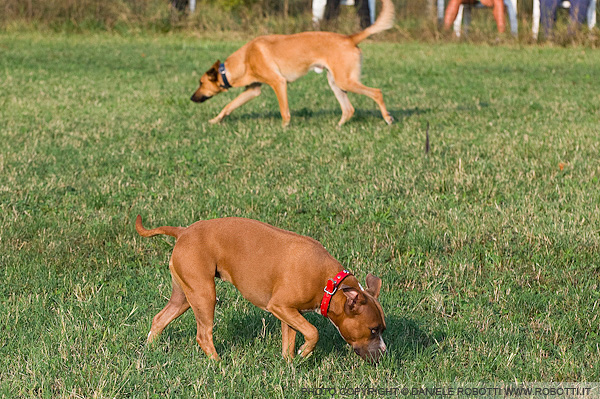
The female American Staffordshire
in the photo is sniffing the ground; the mixed breed
male is walking with head down. The two dogs are
avoiding interacting.
But is my dog really as stressed out as he
seems ?
When talking to owners and explaining the signals their
dogs are giving, there's another question they
inevitably ask: "But is my dog really as stressed out as
he seems to me ?" . And the answer is, yes. If the first
step in understanding is seeing, the second step is
believing what we see. Dogs express their emotional
state, intentions and motivations with a constant stream
of visual, acoustic and olfactory signals. If a dog
displays signs of insecurity, fear or stress, it is
insecure, afraid or stressed. And it's important to see
and recognize these signals, because ignoring them can
have negative effects on the dog's well-being and
behaviour.
Stress is a normal adaptive process, and a natural
response to events that make the dog uneasy. One thing
that helps in coping with stress is having the
possibility to do something that makes us feel better.
If I'm hungry, the fact that I can go into the kitchen
and make myself something to eat makes me feel better.
Eating -- no longer being hungry -- makes me feel
better. When I observe signs of stress in dogs, I don't
just try to understand the cause: I try to understand
what, in that specific context, could help the dog to
feel better. In my job, I identify two phases: coping
strategies and social, mental, emotional and physical
'tools'. Coping strategies are any stimulus or event
that helps to improve a dog's mental and physical state
when faced with a stress-provoking situation. From
puppyhood, my Border Collie Grisou displayed a certain
degree of aggressiveness toward other dogs. Our coping
strategy was playing with a cloth tug. Grisou would bite
and shake the tug toy as if it were a prey animal,
'killing' it ... and this made him feel better.
Physical, social, emotional and mental tools can instead
help dogs to not feel stressed in a given context.
Although it might seem strange, for Grisou one thing
that was also very helpful was a sports training program
in competitive Obedience. Obedience has taught him to
concentrate on a task, and to maintain self-control in
the presence of external stimuli including the presence
of other dogs, or dogs coming into his field of vision.
It also has taught him to trust me, to not feel that he
is in danger in the presence of other dogs, and to
associate the presence of other unfamiliar dogs with
something pleasant and fun.
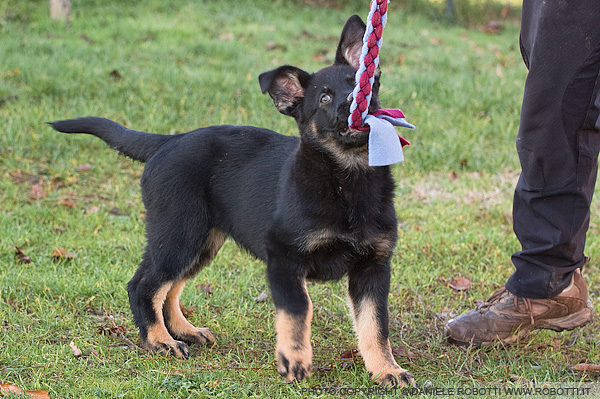
I've used play as a coping strategy not
just with Grisou but also with my other dogs. In this
photo, Arjuna, who was 2 months old at the time, is
playing with a tug toy.
Who I am
Horses were my first real passion. So much so that I
once spent three years observing a herd of wild Camargue
horses in the Cona Island nature reserve at the mouth of
the Isonzo River. That experience taught me to oberve
behaviour, to analyze it and to recognize patterns and
meanings that go beyond what personal experience and
sensitivity make possible. My dissertation on that
research has never been been published, but the
experience hasn't gone to waste, as I have been able to
use it to good advantage in observing dogs from a
scientific perspective. There was a time in my work with
dogs in which I felt like I was watching a film in a
foreign language: I would see two dogs interacting,
without being able to translate their actions or to be
sure of their motivations, intentions and the emotions
they were expressing. In those moments, I went back in
my mind to the long months I spent sitting on the river
bank observing the Camargue horses as if they had been
some unknown animal. And... I drove everything I thought
I knew about dogs, that I had been told about them or
that I had believed, out of my mind and instead begain
to film them, analyse the footage, and learn. Years
earlier, when I had had to learn how to use a clicker
and the principles of positive reinforcement in
learning, I had already had to do something of the kind.
It felt something akin to a difficult trek up a
mountainside: one step after another, each one requiring
a significant effort and yet the source of constant
enthusiasm. The Ethogram research project is the result
of those years of study, and I hope it will help others
to move forward along the path that helped me to better
understand dogs, and which also gave me the tools to
stop just watching dogs and instead begin to see the
world through the eyes of dogs.
Acknowledgements
Although with the passing of time I have taken a
different road than hers, Turid Rugaas is undoubtedly
the person who made me truly aware of stress in dogs. I
participated at a 5-day seminar she held in Rome in
2002, and ever since then my attention has been focused
on the emotional states of dogs, and the effects of
stress on behaviour. The research project on the
rehabilitation of ex-fighting dogs for which I was
responsible from 2004 to 2010 led me to examine my
experiences from a scientific standpoint. Ethologist
Cristina Lorenzi and my husband Giorgio Malacarne were
both invaluable sources of information on how to do
this, and in my struggle to gain knowledge I was
accompanied by the university students who particpated
in the project. In recent years I've had the privilege
of collaborating with ethologist Paola Valsecchi, and of
being able to count on the help and support of many
students, pet owners and friends. Particular thanks go
to Barbara Navone, Barbara Moletta, Marina Garfagnoli,
Sylvie Vouillermoz, Liviana Faoro, Fabio Magnetti, Lola
Banti, and the Gentle Team staff. Many thanks go to
Daniele Robotti for his collaboration, for having made
this project possible, and for opening up his immense
collection of photographs for us to use. I am grateful
to my dogs for sticking with me, and to all the dogs I
have had the good fortune to meet.
What is an ethogram, and why is it a useful
tool ?
Definition: An ethogram
is a complete, detailed description of all the
individual behavioural modules that make up the complete
repertoire of a species, exhibited under specific
environmental conditions.
For each behaviour, I've indicated the author(s) from
whom I take the definition. A list of bibliographical
references is provided at the end of the ethogram.
In contrast with the first two volumes of the ethogram
(those describing the Ethogram of Imposing Behaviours of
the Dog and the Ethogram of Agonistic Behaviours of the
Dog), this volume includes 3 different categories of
behaviour. As I was preparing the different files, and
in particular when writing the captions describing the
photos and videos, I considered whether or not to
distinguish the diffent categories. In the end I chose
not to because it simply isn't possibile to group the
behaviours into clearcut categories. A frightened dog
will also be undergoing stress; a dog that is
de-escalating may also be afraid of his opponent.
As a general rule, the signals that dogs give indicating
fear can be identified as as those associated with the
active avoidance of a stimulus. When I divided the
behaviours related to fear from those indicating stress
for analysis of video clips in a research project on
aggressiveness towards people in dogs, I labelled the
followng behaviours as fear-related: tail down between
the legs, arched/hunched back, ears back, trembling,
flight, panic attacks, seeking refuge, dilation of the
pupils, facial fear displays, squealing/screaming,
whimpering or yelping, showing the whites of the eyes
('whale-eye'), lowered posture, crouching down,
startling and attempting to flee.
How to use this ethogram
An ethogram is a useful tool in that it helps us to
create what ethologists refer to as a search image. For
an herbivore, a typical search image might be a type of
plant; for a predator, a prey animal. For a football
referee, search images would include all of the possible
on-field behaviours by players that would require
intervention. In this ethogram, the relevant search
images regard behaviours related to fear, stress and
de-escalation. The ability to see and recognize them
helps us not only to understand dog behaviour but also,
as a consequence, the possible reactions in a given
situation.
One of the most important benefits of having an ethogram
available to us is that, by providing us with search
images, it gives us tools that can help us to develop
empathy toward dogs. Knowing that a dog is feeling
insecure or afraid or is having serious problems dealing
with a situation helps us to understand how he has
perceived a given context, and to enter into a state of
'resonance' with the dog's emotional states.
Unfortunately, many stress-related behaviours are
completely ignored by dog-owners, and this inability to
perceive what the dog is going through is an impediment
to effective communication with the dog. However, we can
train our eyes to recognize individual behaviours, and
use these behaviours to develop our ability to
understand what dogs are communicating. This phase is a
key part of being in tune with the feelings your dog is
experiencing.
At first, using an ethogram is much like playing a game:
you recognize a behaviour described in the ethogram.
This is an ability I've developed also thanks to the
work done in preparing the ethogram, as this project
involved viewing more than 20,000 photographs and 400
hours of video footage in order to find the best
illustrations for the ethogram ! Today, when I'm
observing a dog, my mind automatically records the
behaviours I see in connection with the context they
occurred in. This process allows me to learn quite a bit
about the dog itself the first time I meet him.
When I adopted Arjuna, my German Shepherd bitch, I flew
to Dusseldorf to pick her up and bring her home. Upon
arriving at the airport, I telephoned her breeder, who
explained where they were, and it wasn't difficult to
find them: all I had to do was follow the sound of
siren-like wailing that stressed-out little Arj was
making-- at the top of her lungs. I hadn't even seen her
yet, but I immediately began to think: insecurity... we
spent several hours with the breeder and Arj's mother,
and when it was time to say goodbye, Arj was able to
accept me as her point of reference. Everything was fine
until the moment of embarking.... Arj was asked to climb
into a kennel carrier, and an electric car carried her
to the cargo hold. At that point, the wailing began
again. The bond that had formed between us transformed
that behaviour from a simple observation into an emotion
--- and a very strong one at that. It was the longest --
and worst -- trip of my (our !) life !
Notes regarding the Ethogram
Of the three ethograms I have published to date, this
is undoubtedly the most complex. There is a vast amount
of information in the scientific literature on fear and
stress, and it was not at all easy to decide what
information to select and include in the introductory
information provided for each behaviour. In the end, I
decided to provide general information, while
purposefully omitting information regarding the
neurophysiology of the behaviours. This is an ethogram,
and its main purpose is to describe and illustrate the
behaviours listed. The References section provides a
bibliography listing texts for interested readers to
consult to find further information and study these
aspects in detail .
I also necessarily made choices regarding the behaviours
to include, and decided to limit the number of
behaviours associated with pathological conditions. As I
see it, an ethogram is a tool with which to understand
the social behaviour of dogs, and pathological
behaviours are outside my field of expertise. It's not
easy to understand when a behaviour is "normal" even if
it constitutes a problem for the owner, and when it is
instead a symptom of discomfort or uneasiness serious
enough to require the help of a specialist. My advice
is, when in doubt, that it always makes sense to seek
guidance from a specialist in the field. This ethogram
is not meant to provide a solution to problems; instead,
it is a tool that can help us to understand that a dog
is having problems.
PART ONE
Introduction
PART
TWO Fear
PART
THREE Stress
PART
FOUR De-escalation behaviours
ETHOGRAM
contents
- authors - bibliography
- books & DVD
|