|
Low posture
Head held lower than the shoulders, tail down, ears
down, legs bent. If the dog is sitting, its head will be
lowered and will appear to be pulled back towards its
chest. If the dog is moving, its forelegs may be lowered
and its hindquarters may appear to be held higher than
its shoulders.
(Murphy, 1998; Beerda et al.,
1999; Tod et al., 2005, Capra, 2011)
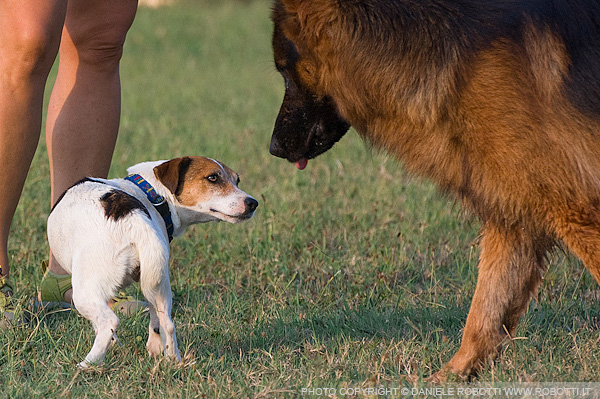
This female Jack Russel is exhibiting a
low posture as she encounters the male German Shepherd.
She stares directly into his eyes, stopping him.
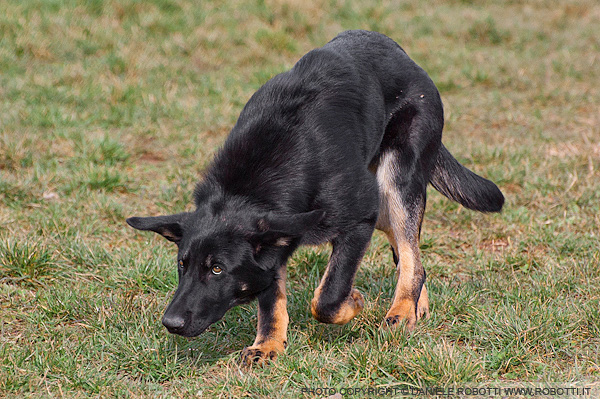
This female German Shepherd is
exhibiting a low posture and airplane ears as she
approaches an unfamiliar dog.
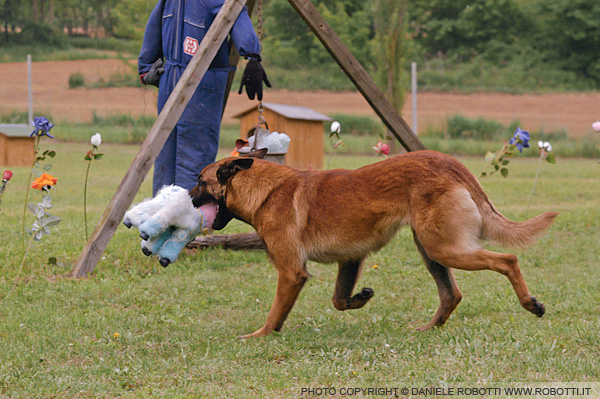
This male Belgian Malinois is performing
in a Mondioring trial. In the retrieving exercise, he is
returning to his handler with ears back, tail down, and
forelegs lowered.
VIDEO
large
screen
Upon entering a strange room, the adolescent Cane Corso
exhibits a low posture.
The dog is pulling on his leash, and exhibiting a
fearful expression towards the people in the room as he
puffs his cheeks.
VIDEO
large
screen
A female Airedale Terrier approaches a female Czech Wolf
Dog. When the Wolf Dog raises her head, the Airedale
changes the direction of her approach and lowers her
head. When the Wolf Dog approaches, the Airedale stops
and stands still, lowers her head and tail, averts her
gaze, adopting a low posture.
The male Australian Shepherd and the Czech Wolf Dog
sniff the Airedale. The Australian exhibits anal-genital
olfactory exploration of the Wolf Dog, who turns her
ears sideways and moves away. The Airedale leaves,
maintaining a low posture,
and the Wolf Dog shakes her head and approaches the male
dog. The Airedale leaves the interaction.
lifting
front paw<>lowering
hindquarters
|
